Physical fitness, technical ability and tactical preparation are essential for sporting success. However, athletes must also concentrate under pressure, recover from mistakes, manage expectations and remain motivated through setbacks.
This is where sports psychology becomes important.
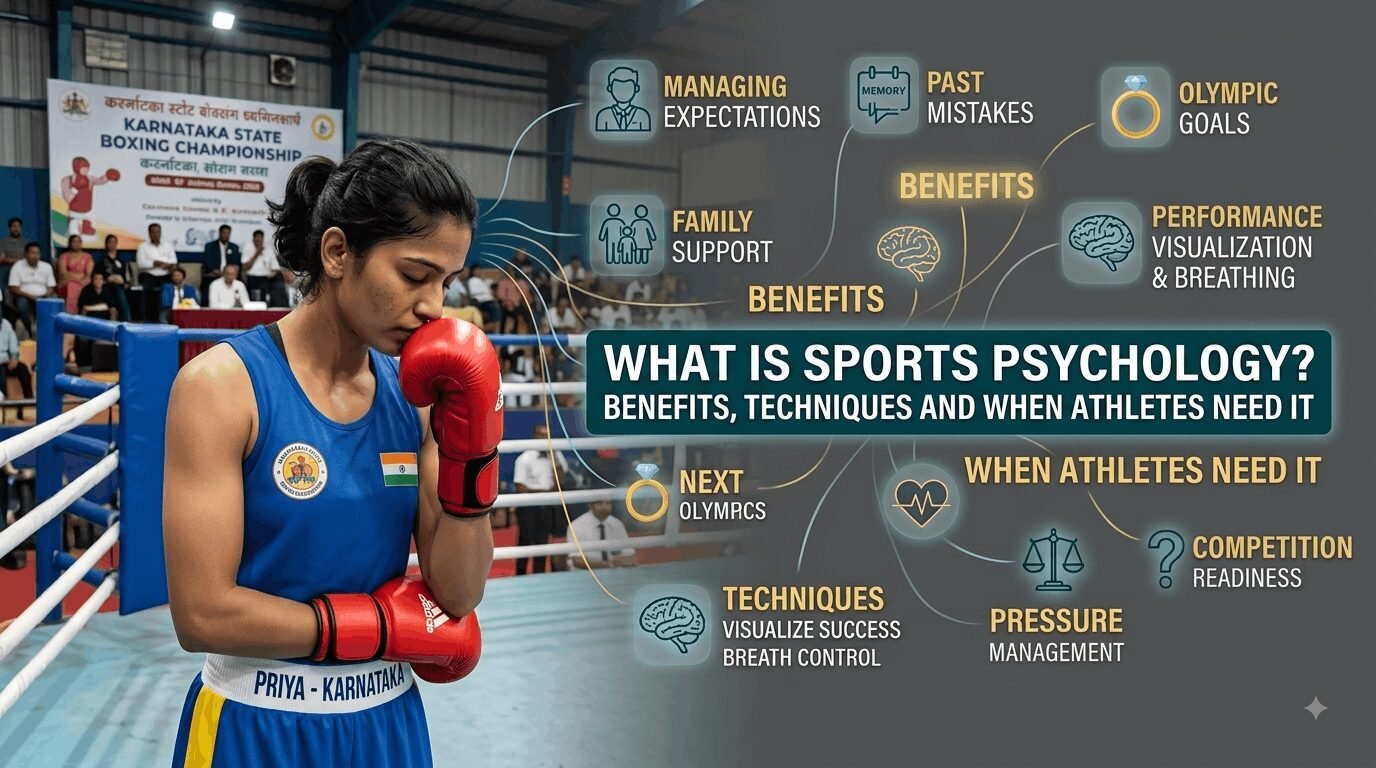
Sports psychology is the use of psychological knowledge and mental-training techniques to support an athlete’s performance, development and well-being. It helps athletes improve focus, confidence, emotional regulation, motivation, resilience and their ability to perform under pressure.
Sports psychology is not only for athletes experiencing a serious problem. It can support beginners, young athletes, elite performers, injured players, coaches and entire teams.
Quick answer: Sports psychology helps athletes understand and train the mental side of performance. Common techniques include goal-setting, visualisation, productive self-talk, breathing exercises, mindfulness, concentration training and pre-performance routines.
Table of Contents
- What is sports psychology?
- What does a sports psychologist do?
- Sports psychology versus mental-health therapy
- Nine benefits of sports psychology
- Key sports psychology techniques
- Which athletes can benefit?
- When should an athlete see a sports psychologist?
- What happens during a session?
- How long does sports psychology take to work?
- How to choose a sports psychologist
- Frequently asked questions
What Is Sports Psychology?
Sports psychology studies how thoughts, emotions, behaviours and relationships influence sports performance and how participation in sport affects psychological well-being.
The American Psychological Association defines sports psychology as a field that uses psychological knowledge and skills to address athletic performance, athlete well-being and the developmental and social aspects of participation in sport.
In practical terms, sports psychology may help an athlete:
- Remain focused during competition
- Manage pre-match anxiety
- Build reliable confidence
- Recover from mistakes
- Respond effectively to pressure
- Maintain motivation during difficult periods
- Set useful training and competition goals
- Cope psychologically with injury
- Communicate with coaches and teammates
- Balance performance with mental well-being
Mental skills require training in the same way as physical and technical skills. Reading about confidence once will not automatically make an athlete confident. The athlete must practise specific psychological skills during training and competition.
What Does a Sports Psychologist Do?
A sports psychologist works with athletes to understand the mental, emotional and behavioural factors affecting their performance and well-being.
Support may involve:
- Identifying performance challenges
- Assessing strengths and development areas
- Setting process, performance and outcome goals
- Developing pre-match and in-match routines
- Managing sports performance anxiety
- Building confidence after setbacks
- Improving concentration
- Changing unhelpful thinking patterns
- Practising visualisation
- Managing emotions
- Supporting injury rehabilitation
- Improving communication
- Helping with motivation and burnout
- Supporting transitions into or out of competitive sport
The work should be personalised. A young swimmer who fears disappointing their parents may require a different approach from an experienced cricketer returning after injury.
Sports psychologists may also work with coaches, parents, academies and teams to create healthier performance environments.
Is Sports Psychology Only About Winning?
No. Winning is one possible outcome, but sports psychology is concerned with both performance and well-being.
An athlete cannot completely control:
- The opponent
- Refereeing decisions
- Selection decisions
- Weather conditions
- Other people’s opinions
- The final result
Sports psychology helps the athlete focus on factors that are more controllable, including preparation, effort, attention, communication, decisions and responses to mistakes.
The objective is not to guarantee victory. It is to help athletes perform more consistently, respond effectively to pressure and develop skills that support both sport and life.
Sports Psychology vs Mental-Health Therapy
Sports psychology and mental-health treatment can overlap, but they are not always the same service.
Sports psychology support | Clinical mental-health support |
Focuses on performance and mental skills | Focuses on psychological distress or a mental-health condition |
May address focus, confidence, routines and pressure | May address anxiety disorders, depression, trauma or eating disorders |
Often includes performance goals and competition plans | Often includes diagnosis or clinical treatment where appropriate |
Can benefit athletes without a mental-health problem | Supports people experiencing significant emotional or psychological difficulties |
Some professionals are trained in both performance psychology and clinical or counselling psychology. Others specialise primarily in mental-performance training.
Athletes experiencing persistent depression, panic attacks, an eating disorder, trauma, substance misuse or thoughts of self-harm should seek an appropriately qualified mental-health professional. Performance enhancement should never replace necessary clinical care.
Nine Benefits of Sports Psychology for Athletes
1. Improved Concentration
Athletes constantly face distractions:
- Crowd noise
- Opponents
- Scores
- Previous mistakes
- Referee decisions
- Pressure from selectors
- Internal negative thoughts
Sports psychology teaches athletes how to recognise when attention has shifted and return it to the most relevant task.
A cricketer might refocus on watching the next delivery. A footballer may scan the field before receiving the ball. A shooter may return attention to breathing, posture and the shot routine.
Concentration does not mean remaining perfectly focused throughout an entire match. It means noticing distraction and returning attention effectively.
2. Better Management of Pressure and Anxiety
Many athletes perform freely during practice but struggle during competition. They may experience:
- Racing thoughts
- Rapid breathing
- Tight muscles
- Nausea
- Fear of failure
- Difficulty making decisions
- Excessive concern about the result
Sports psychology can help athletes understand their response to pressure and develop techniques for regulating it.
These may include controlled breathing, grounding, visualisation, cue statements and consistent pre-match routines. Athletes can learn more in Nudge Sports’ guide to controlling match anxiety.
The goal is not necessarily to remove every nervous feeling. It is to help athletes perform effectively while experiencing normal competitive emotion.
3. More Reliable Confidence
Confidence is often misunderstood as a feeling athletes either possess or lack.
In reality, confidence can be built through:
- Preparation
- Repeated skill execution
- Realistic goals
- Evidence of progress
- Productive self-talk
- Effective recovery after mistakes
- Learning from previous performances
A sports psychologist can help athletes move away from confidence based only on results.
Result-dependent confidence sounds like:
“I am confident only when I win.”
More reliable confidence sounds like:
“I trust my preparation and know how to respond when the match becomes difficult.”
This creates a stronger foundation because even excellent athletes cannot win every competition.
4. Faster Recovery From Mistakes
One mistake often becomes more damaging when the athlete continues replaying it.
For example:
- The athlete makes an error.
- They criticise themselves.
- Attention remains on the error.
- Physical tension increases.
- The next decision becomes rushed.
- Another error occurs.
Sports psychology helps athletes interrupt this cycle using reset routines.
A reset may include:
- One deliberate breath
- A physical release of tension
- A cue such as “next ball”
- Refocusing on the next controllable task
Mental resilience is not the ability to avoid mistakes. It is the ability to respond constructively after them.
5. Clearer and More Effective Goals
Athletes sometimes set only outcome goals:
- Win the tournament
- Make the team
- Score a century
- Achieve a national ranking
Outcome goals can provide direction, but they are not completely controllable. Sports psychology also uses performance and process goals.
Outcome goal: Win the match.
Performance goal: Maintain a first-serve percentage target.
Process goal: Complete the same breathing and serving routine before each point.
The Association for Applied Sport Psychology’s goal-setting guidance recommends using practice goals alongside competition goals and ensuring that athletes understand and take ownership of their goals.
6. Greater Motivation and Consistency
Motivation naturally changes. Athletes may feel less motivated during:
- Long training phases
- Academic pressure
- Repeated losses
- Non-selection
- Injury rehabilitation
- Conflict with a coach
- Performance plateaus
- Burnout
Sports psychology helps athletes understand their reasons for participating, reconnect with personal values and create manageable daily actions.
Instead of waiting to feel motivated, the athlete develops routines that support consistent behaviour.
This may include:
- Setting weekly process goals
- Tracking progress
- Connecting training to a meaningful purpose
- Building accountability
- Recognising small improvements
- Adjusting unrealistic expectations
7. Stronger Emotional Regulation
Sport can create frustration, anger, disappointment, embarrassment and fear.
Suppressing every emotion is not the objective. Athletes need to recognise emotions without allowing them to control the next decision.
Sports psychology may help athletes:
- Notice early signs of emotional escalation
- Identify common triggers
- Use breathing and grounding
- Communicate more effectively
- Respond instead of reacting
- Accept temporary discomfort
- Refocus on the next action
Emotional regulation is particularly important in sports involving long matches, physical contact, judging decisions or repeated opportunities for mistakes.
8. Psychological Support During Injury
Injuries affect more than the body. Athletes may experience:
- Loss of identity
- Fear of falling behind
- Frustration
- Isolation from the team
- Reduced confidence
- Fear of reinjury
- Uncertainty about returning to competition
Sports psychology can support goal-setting, adherence to rehabilitation, confidence and emotional adjustment.
Mental imagery may also help injured athletes remain connected with their skills and prepare psychologically for returning to play. The Association for Applied Sport Psychology discusses imagery and confidence as part of mental preparation during injury rehabilitation.
Medical clearance must still come from the athlete’s qualified healthcare team.
9. Improved Communication and Team Culture
Performance is influenced by relationships with:
- Coaches
- Teammates
- Parents
- Support staff
- Medical professionals
- Strength and conditioning teams
Sports psychologists may help athletes and teams improve:
- Role clarity
- Feedback
- Conflict management
- Leadership
- Trust
- Shared goals
- Communication under pressure
- Response to selection and non-selection
A technically talented team may still struggle when players do not trust one another or understand their responsibilities.
Core Sports Psychology Techniques
1. Goal-Setting
Goal-setting gives athletes direction and helps turn a large ambition into specific actions.
Effective goals should be:
- Personally meaningful
- Challenging but realistic
- Clearly defined
- Measurable
- Reviewed regularly
- Connected to daily behaviour
Athletes should use a combination of outcome, performance and process goals.
2. Visualisation and Mental Imagery
Visualisation involves mentally rehearsing performance using realistic detail.
An athlete may imagine:
- Entering the venue confidently
- Executing a technical skill
- Following a tactical plan
- Responding to pressure
- Recovering after a mistake
- Handling an unexpected situation
The Association for Applied Sport Psychology explains that imagery can help athletes manage competition anxiety, maintain confidence, improve focus and support motivation.
Effective imagery should include realistic challenges—not only perfect outcomes.
3. Productive Self-Talk
Self-talk is the internal language athletes use before, during and after performance.
Unhelpful self-talk:
- “I always fail under pressure.”
- “I cannot make another mistake.”
- “The opponent is much better than me.”
Productive alternatives:
- “Focus on the next action.”
- “Breathe and reset.”
- “Trust the preparation.”
- “Strong and simple.”
Productive self-talk does not require pretending everything is perfect. It should be realistic, brief and connected to a useful action.
A 2025 article from the Association for Applied Sport Psychology explains that athletes can learn to view negative thoughts as temporary mental events rather than unquestionable facts.
4. Breathing and Relaxation Skills
Controlled breathing can help athletes regulate physical tension and bring their attention back to the present.
A simple method is to:
- Relax the jaw and shoulders.
- Breathe in gently through the nose.
- Breathe out slowly.
- Allow the exhalation to be slightly longer.
- Repeat without forcing the breath.
Athletes should practise breathing exercises during training and recovery—not only when anxiety becomes intense.
5. Mindfulness and Present-Moment Attention
Mindfulness involves noticing thoughts, feelings and physical sensations without immediately reacting to them.
An athlete may notice:
- “I am thinking about the result.”
- “My shoulders feel tight.”
- “I am worried about making another mistake.”
The athlete can then redirect attention to the current task.
Mindfulness is not the absence of thought. It is the ability to recognise where attention has gone and return it intentionally.
6. Pre-Performance Routines
A pre-performance routine is a consistent sequence of thoughts and actions before a skill or competition.
Examples include:
- A golfer’s routine before a shot
- A cricketer’s routine before each delivery
- A tennis player’s routine before serving
- A shooter’s breathing and setup sequence
- A football team’s pre-match preparation
Routines can reduce uncertainty and give athletes something familiar to follow under pressure.
7. Attention-Control Training
Attention-control training helps athletes decide:
- What deserves attention
- What can be ignored
- When attention should be broad
- When attention should narrow
- How to refocus after distraction
A footballer may need broad awareness of players and space. A shooter may require narrow attention on breathing and technique. Attention requirements change across sports and situations.
8. Performance Profiling
Performance profiling helps athletes assess mental, technical, tactical and physical qualities.
The athlete may rate areas such as:
- Confidence
- Focus
- Motivation
- Resilience
- Emotional control
- Communication
- Decision-making
- Response to mistakes
This creates a starting point for goal-setting and makes mental development more measurable.
Nudge Sports’ free NudgeMetrics assessment maps an athlete’s perceived strengths across commitment, control, challenge and confidence.
9. Pressure Training
Mental skills should be tested under realistic conditions.
Coaches can introduce pressure by:
- Adding time limits
- Creating score-based scenarios
- Allowing only one attempt
- Using consequences appropriate to training
- Recreating crowd or tournament conditions
- Practising after fatigue
- Requiring athletes to reset after mistakes
Pressure training should be planned and psychologically safe. Its purpose is to teach effective responses—not humiliate or frighten athletes.
Who Can Benefit From Sports Psychology?
Sports psychology can benefit:
- Young athletes
- Beginners
- Professional athletes
- Individual-sport athletes
- Team-sport athletes
- Athletes returning from injury
- Athletes facing selection
- Coaches
- Parents
- Referees
- Entire teams and academies
An athlete does not need to wait for a crisis. Mental training can begin alongside physical and technical training.
Nudge Sports’ PEP for Athletes supports beginner, competitive and experienced athletes with the psychological demands of sport and life.
When Does an Athlete Need Sports Psychology?
An athlete may benefit from sports psychology when they:
- Perform better in training than in competition
- Experience repeated pre-match anxiety
- Lose confidence after mistakes
- Struggle to remain focused
- Avoid challenging situations
- Find it difficult to recover from losses
- Feel overwhelmed by expectations
- Struggle with motivation
- Are returning after injury
- Fear reinjury
- Experience conflict with coaches or teammates
- Become excessively self-critical
- Have difficulty balancing sport, education and life
- Want to improve performance proactively
Sports psychology is also valuable when things are going well. Athletes can use it to strengthen effective habits, prepare for higher competition levels and maintain consistency.
When Is Clinical Mental-Health Support Needed?
A qualified mental-health professional should be consulted when an athlete experiences:
- Persistent anxiety affecting daily life
- Panic attacks
- Ongoing low mood
- Loss of interest in sport and other activities
- Major sleep or appetite changes
- Disordered eating
- Substance misuse
- Trauma symptoms
- Severe burnout
- Self-harm
- Thoughts of suicide
Athletes are not immune to mental-health difficulties. High expectations, travel, injury, selection uncertainty and public attention can create additional stress.
Seeking support is a responsible performance and health decision—not a sign of weakness.
What Happens in a Sports Psychology Session?
The first session usually focuses on understanding the athlete rather than immediately giving generic motivational advice.
A practitioner may explore:
- The athlete’s sporting background
- Current goals
- Training and competition environment
- Strengths
- Main challenges
- Thoughts before and during competition
- Physical response to pressure
- Relationships with coaches and parents
- Previous strategies
- Lifestyle and recovery
- Expectations from support
The practitioner and athlete can then create a plan involving specific mental skills.
For example:
Athlete’s challenge | Possible area of work |
Pre-match anxiety | Breathing, routines and attention control |
Low confidence | Evidence-based confidence plan and self-talk |
Poor concentration | Attention cues and refocusing routines |
Difficulty after mistakes | Reset routine |
Lack of motivation | Values, goals and progress monitoring |
Fear after injury | Gradual exposure, imagery and confidence |
Team conflict | Communication and role clarity |
Sessions should be collaborative. The athlete should understand why a technique is being used and how to practise it between sessions.
How Long Does Sports Psychology Take to Work?
There is no fixed timeline.
Some athletes may notice an immediate improvement after learning a practical routine. More lasting change generally requires repeated practice across training and competition.
Progress depends on:
- The challenge being addressed
- How long it has existed
- The athlete’s age and development
- Competition demands
- Training consistency
- Coach and parent support
- Frequency of practice
- Mental-health considerations
- Willingness to reflect and experiment
Sports psychology should not be viewed as a one-time motivational conversation. It is a training process.
How to Choose a Sports Psychologist
Before working with a practitioner, ask:
- What are your sports psychology qualifications?
- What experience do you have with my sport and age group?
- Do you work primarily with performance, mental health or both?
- How do you assess an athlete’s requirements?
- What techniques do you use?
- How is progress reviewed?
- How do you maintain confidentiality?
- When are parents or coaches involved?
- Can you refer athletes for clinical care when needed?
- Do you offer online and in-person sessions?
Qualifications, experience, ethical practice and the athlete’s comfort with the practitioner are more important than motivational claims.
Nudge Sports works with qualified sports psychology professionals across different cities and sports. Athletes can explore the available sports psychology programs or book a suitable plan.
Frequently Asked Questions About Sports Psychology
1. What is sports psychology in simple words?
Sports psychology is the mental side of sports training. It helps athletes improve focus, confidence, motivation, emotional control, resilience and performance under pressure.
2. What are the main benefits of sports psychology?
The main benefits include better concentration, improved confidence, pressure management, clearer goals, faster recovery after mistakes, greater motivation and stronger communication.
3. What techniques are used in sports psychology?
Common sports psychology techniques include goal-setting, visualisation, self-talk, breathing exercises, mindfulness, attention training, pre-performance routines and performance profiling.
4. Who needs a sports psychologist?
Any athlete who wants to improve mental skills may benefit. Sports psychologists also support athletes experiencing anxiety, low confidence, loss of motivation, injury-related fear or difficulty performing consistently.
5. Is sports psychology only for professional athletes?
No. Young athletes, beginners, school teams, coaches and parents can all benefit. Learning mental skills early may help athletes develop healthier performance habits.
6. Can sports psychology improve performance?
Sports psychology can help athletes strengthen mental skills that influence performance, including focus, confidence, emotional regulation and response to pressure. It cannot guarantee a particular result.
7. Can a sports psychologist help with anxiety?
Yes. Sports psychologists can help athletes understand performance-related anxiety and practise breathing, attention, self-talk, imagery and routine-based strategies. Severe or persistent anxiety may require a clinically qualified mental-health professional.
8. What is the difference between a sports psychologist and a coach?
A coach generally teaches physical, technical and tactical aspects of a sport. A sports psychologist specialises in psychological skills, performance behaviour and athlete well-being. They may collaborate as part of the same support team.
9. How often should an athlete meet a sports psychologist?
The frequency depends on the athlete’s needs, goals and competition schedule. Some athletes begin with regular sessions and reduce the frequency as they develop independent mental skills.
10. At what age can an athlete start sports psychology?
Mental skills can be introduced in age-appropriate ways from childhood. Young athletes may work on enjoyment, confidence, emotional awareness, focus and responding to mistakes rather than advanced psychological concepts.
11. Does seeing a sports psychologist mean an athlete is mentally weak?
No. Working with a sports psychologist is similar to working with a specialised coach. It allows athletes to develop skills that are important for performance and well-being.
12. Can sports psychology help injured athletes?
Yes. It can support confidence, motivation, rehabilitation adherence, emotional adjustment and preparation for returning to sport. Medical diagnosis and physical clearance must still come from qualified healthcare professionals.
Final Takeaway
What is sports psychology? It is the structured training of psychological skills that help athletes perform, develop and protect their well-being.
It can help athletes:
- Focus on the present task
- Manage competition pressure
- Build reliable confidence
- Recover after mistakes
- Set effective goals
- Maintain motivation
- Regulate emotions
- Cope with injury
- Communicate more effectively
Sports psychology is not a last resort and is not limited to elite performers. It can become a regular part of an athlete’s preparation alongside technical practice, fitness, nutrition and recovery.
The strongest athletes are not those who never experience fear, doubt or disappointment. They are athletes who learn how to recognise these experiences and respond in ways that support their next action.
For personalised mental training, explore Nudge Sports’ sports psychology services or book a plan.